

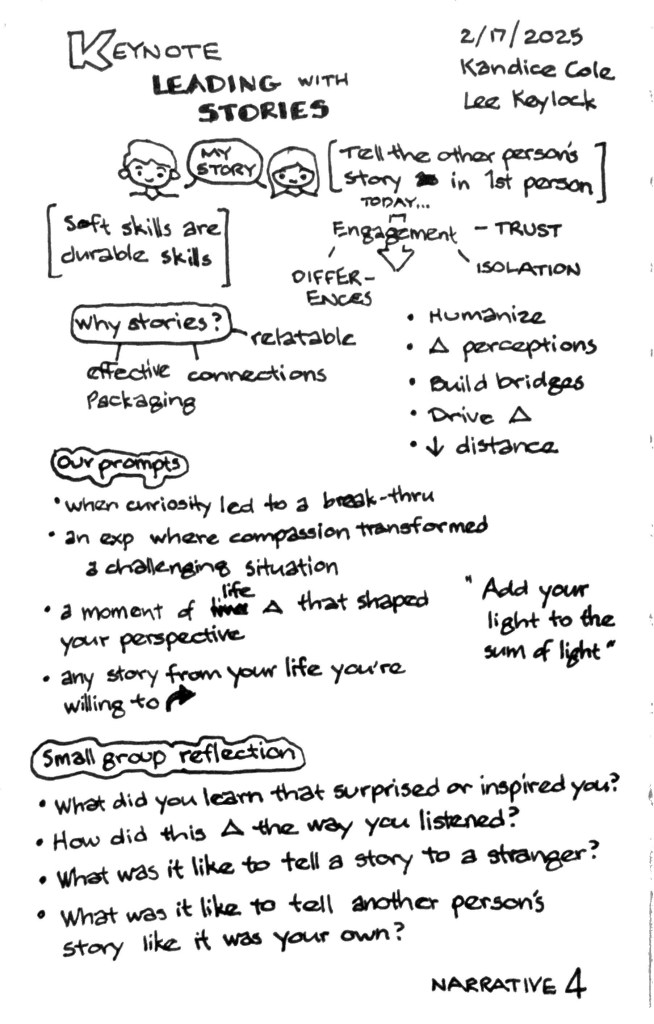
One of the keynote sessions from the Training 2025 conference I attended in February was titled, “Leading with Stories,” presented by Kandice Cole and Lee Keylock. Their company works with groups to tell stories, which results in better relationship connections.
After introducing the concept, we separated into pairs. None of the prompts the presenters suggested resonated with Amanda (my partner) and me, and we both had story ideas we thought of before the activity started. We decided to share our stories. It turned out that both of us shared marriage stories about how we met our partners and challenges we faced.
What really made this impactful was that we shared each others’ stories as though it was our own – in the first person. We joined with another pair and retold our partner’s story. It was a great experience that connected us throughout the conference.
My visual notes from “Leading with stories”
Repeating the activity
Not too long after the conference I had the opportunity to run some team building activities with teens. I decided to try this activity.
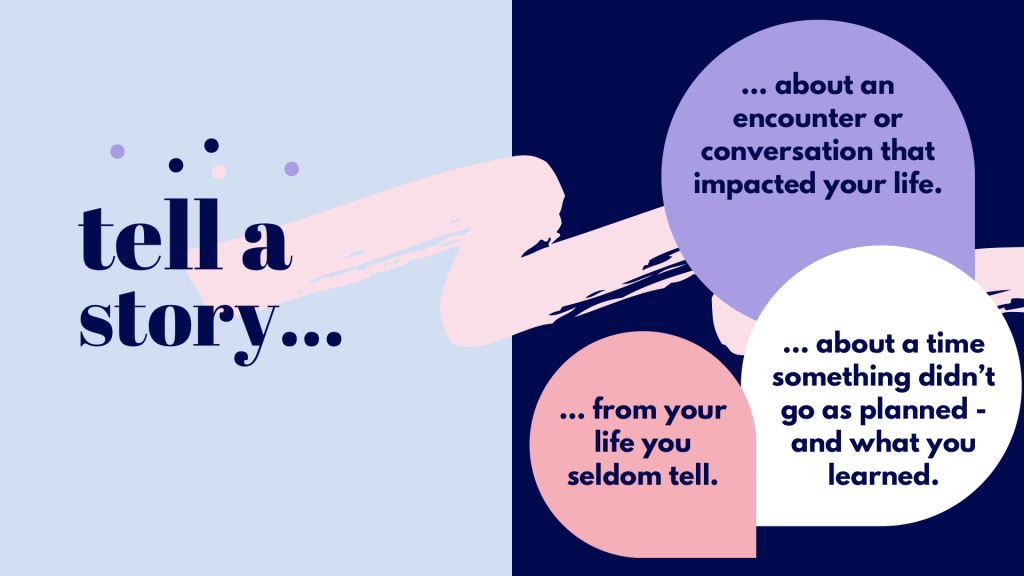
I used these prompts: Tell a story …
- … about an encounter or conversation that impacted your life.
- … about a time something didn’t go as planned – and what you learned.
- … from your life you seldom tell.
At first the participants were hesitant, but they each shared stories as pairs and as combined pairs. When the group came back together, I asked for a couple of volunteers to share their partners’ stories. The retellings in the group setting were entertaining and dramatic, and eventually everyone shared their partners’ stories.
The visual notes I took were a helpful reference as I prepared for my own version of the storytelling. 
Look At My Notes
Visual notes consist of text and graphical elements arranged to enhance learning. Because emphasizing content visually makes it memorable, visual notes are ideal for learning, training, and handouts.
In Look At My Notes you will learn (1) how to take and share visual notes with others, (2) why visual notes are effective, and (3) what to include in your visual notes.

 Notes For Learning