

Training Magazine Network offers a variety on webinars on learning, presenting, and development. I registered for “present without PowerPoint” as soon as I received a promotional email.
The presenter, Glenn Gibson, is author of Before The Mic: How to compose meaningful, memorable, and motivational presentations. He is also a speaker and coach (BeforeTheMic.com).
Visual Notes for Present Without PowerPoint: Could Ya? Would Ya?
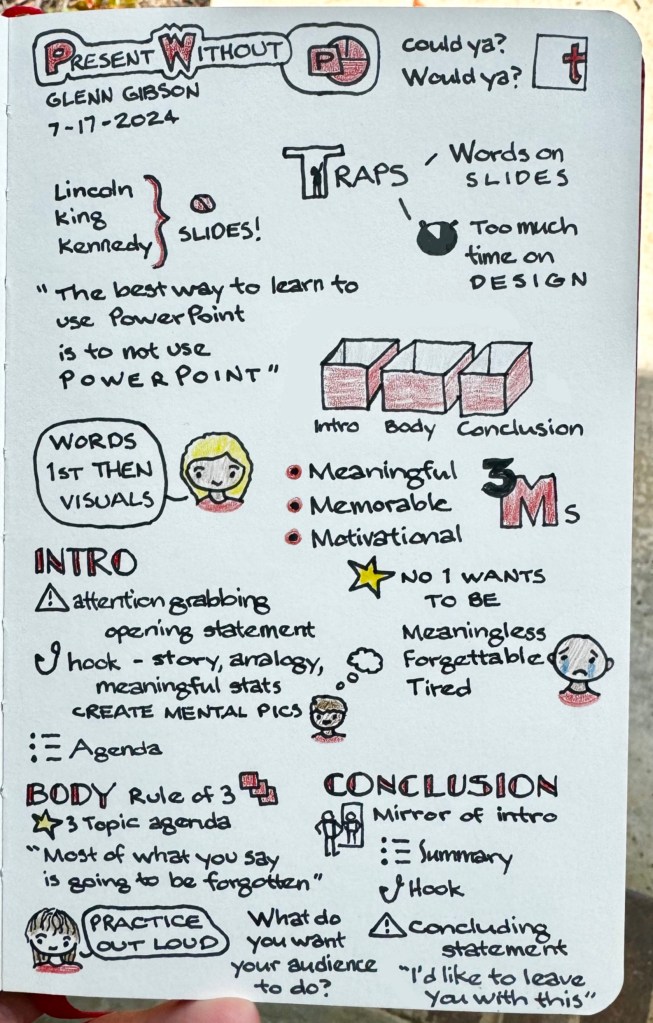
Abraham Lincoln, Martin Luther King Jr., and John F. Kennedy did not need PowerPoint to create memorable speeches. Of course, PowerPoint itself did not exist then, but there have been slides and visuals for many years. Even so, throughout the bulk of human history speeches succeeded without PowerPoint.
Today, we have an over-reliance on PowerPoint. Two traps exist when it comes to PowerPoint. One end of the continuum is when presenters start crafting their presentations in PowerPoint, which results in text heavy slides that they just read during the presentation. Numerous studies have found that attendees cannot absorb words simultaneously from multiple sources. Thus, the message is lost. The second trap is to spend too much time on slide design.
The best way to learn to use PowerPoint is not to use PowerPoint.
Glenn structured his webinar around 3 words that start with “M.” Presentations need to be meaningful, memorable, and motivational. Sometimes we think that mundane presentations, like project updates or financial projects, can be exempt from being meaningful, memorable, and motivational, but the opposite states of the M’s are meaningless, forgettable, and boring (or tired or lame), which no presenter or audience wants.
Glenn tied each “M” to a phase of the presentation:
- Intro = Meaningful
- Body = Memorable
- Conclusion = Motivational
Intro
- Start with an attention-grabbing opening statement.
- Hook the audience with a story, analogy, or meaningful statistic. Create mental pictures.
- Share the basic outline of the presentation (hint: it has 3 points).
Body
- Have a 3-part agenda.
- Use the rule of 3s to create memorability.
- Ask: What do you want your audience to do?
Glenn shared the example of someone who wanted to present on The 7 Habits of Highly Effective People (Stephen Covey). The presenter planned to cover each of the habits. Glenn asked the presenter what he really wanted as the outcome of the presentation, which was to motivate attendees to pick up free copies of the book from human resources and read it. Instead of reviewing the 7 habits, the presenter effectively made the case for why reading the book would be beneficial.
Most of what you say is going to be forgotten.
Conclusion
- The conclusion should be a mirror of the intro: summary of points, hook, and concluding statement.
- End with “I’d like to leave you with this …”
- If you leave time for questions and answers, still be prepared to end the presentation with a concluding statement.
 Notes For Learning